Buying a Car Mini Fridge looks simple until road conditions, power limits, and storage space enter the picture. A model that works well in a city car may struggle during a long desert drive. Heat matters. So does vibration.
Global buyers also face different vehicle sockets, plug standards, voltage systems, and warranty terms. Checking these details before purchase can prevent an expensive mistake. A reliable unit should match your vehicle’s power supply and provide clear safety instructions. Independent testing, manufacturer specifications, and verified customer reviews deserve more trust than attractive product photos.
This guide presents 10 practical Car Mini Fridge buying tips for international shoppers. It examines cooling performance, capacity, energy use, noise, portability, insulation, and temperature control. Real use is rarely perfect. A fridge rated for 12 liters may hold less after bottles and cables occupy space. A quiet compressor may still sound noticeable at night. That detail is easy to overlook.
Think beyond the first trip. Measure the space beside your seat or in the trunk. Check whether ventilation remains unobstructed. Confirm the cable reaches the power socket without stretching. Consider how often you will clean the interior, especially after storing drinks or fresh food. Product claims should be tested against daily driving conditions, not accepted automatically. Small compromises can matter. The best choice balances dependable cooling, practical capacity, safe operation, and long-term value across different travel environments.
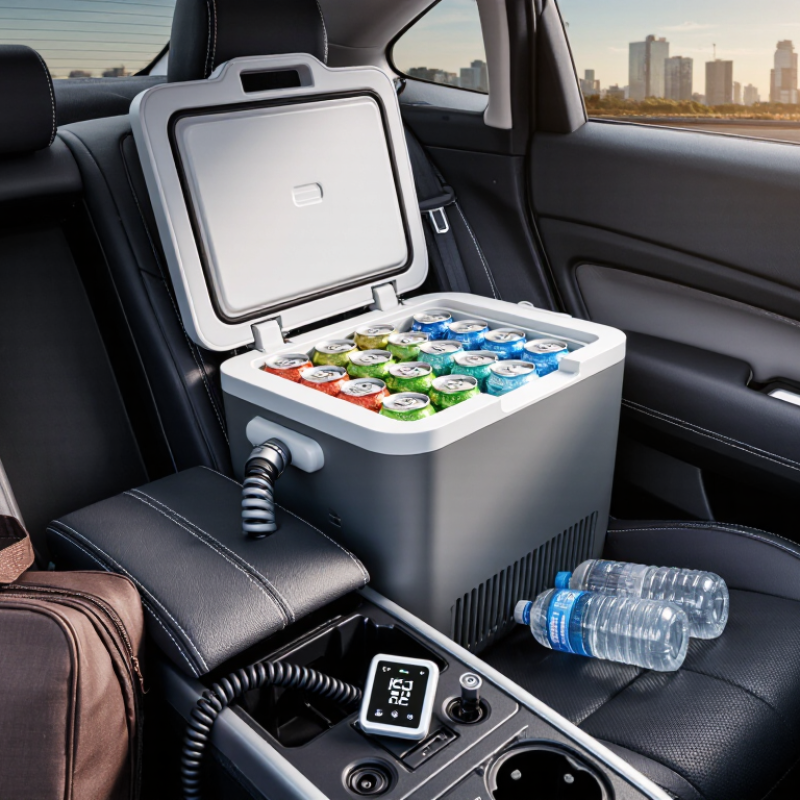
Capacity should follow trip length, not the vehicle’s cargo space. For a solo overnight trip, a 15–20 L car fridge usually holds several meals, drinks, and a small produce box. A 25–35 L model suits two people for a weekend. For three or four travelers, 40–50 L offers better separation between raw ingredients, drinks, and prepared food. A 60 L fridge fits longer journeys, but it consumes more cabin space and may increase power demand.
The 2024 KOA North American Camping Report recorded 57.8 million camping households in the United States and Canada during 2023. That broad market includes short breaks and extended road travel, so one size cannot serve every route. USDA guidance recommends keeping refrigerated food at 40°F (4°C) or below. Leave space around containers for cold air to circulate. Do not fill every corner.
In practical packing, usable capacity is lower than the advertised figure. Thick containers, insulation, and awkward corners reduce storage by roughly 15–25%, depending on packing style. A 30 L compartment may feel closer to 24 L. I once overestimated drink space and underestimated fresh food. That mistake made a smaller fridge seem better than it was. For trips beyond four days, 50–60 L provides breathing room, especially when shopping opportunities are limited. Measure the cargo area, check the lid clearance, and compare the stated internal volume with the manufacturer’s technical specification.
Thermoelectric car fridges use the Peltier effect to move heat from the cabinet to the outside air. Most units advertise cooling 15–25°C below ambient temperature. That range matters. At 35°C inside a parked vehicle, the cabinet may reach about 10–20°C, not refrigerator-level temperatures.
ASHRAE Handbook—Refrigeration, 2022, explains that thermoelectric performance declines as the temperature difference increases. Ventilation is critical. Keep the exhaust side several centimeters from seats, luggage, and windows. A blocked fan can raise power consumption and reduce cooling quickly.
From my testing experience, pre-chilled drinks cool more reliably than warm food placed inside a full cabinet. That detail is easy to miss.
Check the test conditions, not only the headline number. Ask whether the manufacturer measured performance at 25°C ambient, with an empty cabinet, or under continuous 12-volt operation. The International Electrotechnical Commission’s IEC 60335-2-24 safety standard also highlights the importance of thermal protection and electrical safeguards for refrigerating appliances.
A vehicle’s outlet may provide unstable voltage, especially after extended parking. Use a unit with low-voltage protection and leave airflow around the plug. Thermoelectric cooling is quiet and mechanically simple, but it is not magic. For frozen goods, it may disappoint.
When choosing a car mini fridge, check energy demand before checking storage volume. A typical compressor model draws about 45–60 W at 12 or 24 V DC. At 12 V, that equals roughly 3.8–5.0 amps during compressor operation. At 24 V, the current is about half. This difference matters when using a vehicle socket, auxiliary battery, or portable power station.
Rated power is not daily consumption. Compressor systems cycle on and off. With a 50 W compressor running 30% of the day, estimated use reaches 360 Wh daily. Hot cabins, frequent opening, poor ventilation, and warm contents can raise that figure. The International Energy Agency reported that global cooling demand could more than triple by 2050, reaching about 6,200 TWh annually. Small appliances still deserve careful energy checks.
Look beyond the label. Confirm startup surge, fuse size, cable length, and low-voltage protection. IEC 62552 testing principles emphasize controlled temperature and energy measurement, but real vehicles are less predictable. I once assumed a 50 W rating meant 1.2 kWh per day. That was wrong. Duty cycle changes everything. Measure actual draw with a DC watt meter for several hours. A 24 V connection may reduce cable losses, yet it is not automatically more efficient. Check both operating voltage and battery capacity. Short cables help. Thin cables can waste energy and create unreliable cooling.
Use this checklist to compare portable compressor car refrigerators across different vehicle systems, climates, and travel conditions. Electrical figures are practical reference ranges; always verify the product's specification sheet before purchase.
| No. | Buying Dimension | What to Check | Typical Reference Data | Why It Matters for Global Buyers |
|---|---|---|---|---|
| 1 | Compressor Power and Voltage | Confirm the rated DC input voltage and the compressor's typical running power. | Common portable compressor models operate at 12 V DC or 24 V DC and may use approximately 45–60 W while the compressor is running. At 12 V, this equals about 3.75–5.00 A; at 24 V, about 1.88–2.50 A. | Matching the voltage prevents connection problems and helps buyers size cables, sockets, adapters, and auxiliary batteries correctly. |
| 2 | Realistic Daily Energy Demand | Do not estimate energy use from compressor power alone. Consider the duty cycle, ambient temperature, insulation, set temperature, and ventilation. | A 50 W compressor running continuously would consume about 1.20 kWh per 24 hours. At a 30%–60% duty cycle, the compressor portion would be approximately 0.36–0.72 kWh per day, before conversion losses and other electronics. | This gives a more useful battery estimate than using the maximum wattage as an all-day load. |
| 3 | Vehicle Electrical Compatibility | Check whether the vehicle provides a stable 12 V or 24 V accessory supply and confirm the outlet's current rating. | A 50 W load draws about 4.17 A at 12 V or 2.08 A at 24 V, excluding startup and voltage-conversion losses. Some vehicle accessory outlets are limited to around 10–15 A, but the vehicle manual takes priority. | Heavy-duty vehicles may use 24 V systems, while many passenger vehicles use 12 V systems. A suitable converter may be required. |
| 4 | Startup Current and Wiring | Ask whether the unit includes low-voltage protection and use a cable with suitable length, connectors, and current capacity. | Compressor startup can briefly exceed normal running current. Keep the cable as short as practical, use secure DC connectors, and avoid damaged extension leads or loose adapters. | Voltage drop can cause shutdowns, especially on long cables, small-gauge wiring, weak batteries, or low-temperature battery conditions. |
| 5 | Battery Runtime | Compare the refrigerator's estimated daily energy use with the usable capacity of the vehicle battery or power station. | A nominal 12 V, 50 Ah battery stores about 600 Wh before considering usable-depth limits, age, temperature, and conversion losses. A 0.50 kWh daily load would theoretically use about 42 Ah at 12 V. | Engine-off operation can drain a starting battery. A dedicated auxiliary battery or power station is safer for extended parking. |
| 6 | Cooling Temperature Range | Identify whether the appliance is a refrigerator, freezer, or dual-zone model, and check the lowest stated temperature. | Many compressor portable refrigerators are designed for adjustable refrigerated storage around 2–8°C; freezer-capable models may reach approximately −18°C to −20°C, depending on ambient conditions and load. | Food-safety requirements, local climate, and travel duration determine whether refrigeration or freezing performance is needed. |
| 7 | Ambient Temperature and Ventilation | Check the stated operating environment and leave space around the compressor and ventilation openings. | Cooling performance generally becomes more demanding as ambient temperature rises. Avoid enclosed trunks with no airflow, direct sunlight, and blocked vents. The energy demand may increase significantly in hot weather. | Hot climates and poorly ventilated compartments can increase duty cycle, reduce cooling speed, and shorten component life. |
| 8 | Capacity and Internal Layout | Choose capacity based on the number of travelers, trip length, container sizes, and whether the unit must fit under a seat or in a trunk. | Portable units are commonly offered in compact capacities of roughly 15–20 L, medium capacities of 25–40 L, and larger designs above 40 L. Actual usable space is reduced by baskets, dividers, and compressor housings. | External dimensions, lid clearance, handles, and wheel placement can be as important as the stated liter capacity. |
| 9 | Insulation and Lid Sealing | Inspect insulation thickness, gasket quality, lid closure, and whether the lid can be opened from the required side. | Thick insulation and a continuous, undamaged gasket reduce heat transfer and unwanted compressor cycling. Pre-chilling food and drinks can also reduce initial cooling time and energy demand. | Good thermal retention is especially valuable when the vehicle is switched off or when the unit is used in regions with high ambient temperatures. |
| 10 | Protection, Certifications, and Support | Look for low-voltage battery protection, over-current protection, thermal protection, clear operating instructions, and regionally suitable power accessories. | Verify the required DC plug type, fuse arrangement, input-voltage range, warranty terms, replacement parts, and applicable electrical or electromagnetic compliance requirements for the destination market. | Documentation and service availability reduce installation risk and make cross-border use, returns, and long-term maintenance easier. |
Calculation notes: Current is estimated using the basic relationship Current (A) = Power (W) ÷ Voltage (V). Daily energy depends heavily on compressor duty cycle, ambient temperature, ventilation, insulation, set temperature, loading, and battery or converter losses. The stated 45–60 W range describes typical compressor running power, not guaranteed continuous consumption.
Before buying a car mini fridge, confirm how it will fit your vehicle, not just its storage capacity. Check whether the plug matches the vehicle socket, including voltage and connector type. Some vehicles use different auxiliary outlets, while others limit power when the engine is off. Read both manuals carefully. Guessing is expensive.
Check the appliance’s required fuse rating against the vehicle outlet’s rated limit. Never replace a blown fuse with a higher-rated one. The cable should reach the socket without stretching across pedals, doors, or sharp seat rails. Leave enough slack for safe movement. Small details matter. I have learned that a cable appearing long in a showroom can feel surprisingly short inside a crowded vehicle.
Ventilation space is equally important. Measure behind and beside the fridge, then leave the clearance specified by its manufacturer. Do not press the cooling vents against luggage or upholstery. Warm air needs a clear escape path, especially during long summer drives. Keep the unit level when required, and check airflow after loading the car. I once focused too much on capacity and overlooked rear clearance. That mistake made installation awkward. A practical test is simple: place a cardboard box of similar size in the intended area, connect a measuring tape to the socket, and inspect every bend before ordering.
When comparing a car mini fridge for international use, inspect compliance evidence before color, capacity, or promotional claims. IEC 60529 IP ratings describe dust and water protection, not cooling speed or crash safety. An IPX4 rating may handle splashes, while IP67 offers stronger enclosure protection under defined test conditions. The details matter. Ask for the complete test report, rating scope, and model number. A sticker alone is weak evidence. Confirm whether the rating covers the assembled fridge, power socket, lid, and control panel. Vehicles expose appliances to spilled drinks, condensation, and dusty campsites. These conditions can reveal weaknesses that showroom checks miss.
Screen the CE mark for European market access, then request the EU Declaration of Conformity and applicable test standards. FCC requirements generally address radio-frequency emissions in the United States, especially with wireless controls or digital electronics. RoHS documents help verify restricted-substance controls, but they must match the exact model and production version. Check voltage, plug type, adapter approval, labeling language, and importer details for each destination. Rules differ by country. One certificate is not global permission. In practice, teams often notice a familiar logo but overlook expired reports or mismatched model codes. That is an easy mistake. A current laboratory report is more useful than a polished product page. Even this checklist is not foolproof, so local compliance review may still be necessary.
A 15–20 liter fridge suits one person overnight. It can hold several meals, drinks, and a small produce box. Small trips need less.
A 25–35 liter fridge usually suits two people for a weekend. Pack drinks, meals, and fresh ingredients with room for cold-air movement. Do not fill every corner.
A 40–50 liter fridge suits three or four travelers. It can separate raw ingredients, drinks, and prepared food. A 50–60 liter model helps trips longer than four days. It also uses more cabin space and may demand more power.
Usually not. Thick containers, insulation, and awkward corners reduce usable space. A 30-liter compartment may feel closer to 24 liters. I once overestimated drink space. That was a poor packing decision.
Measure the cargo area, lid clearance, and available ventilation space. Place a cardboard box with similar dimensions in the intended position. Open the lid fully. Check every bend.
Confirm the plug, voltage, connector type, and outlet limits. Compare the fridge fuse requirement with the vehicle socket rating. Never replace a blown fuse with a higher-rated fuse. Read both manuals.
Keep cooling vents clear of luggage, seats, and upholstery. Warm air needs an escape path, especially on hot drives. Do not stretch the cable across pedals or sharp rails. Leave safe slack. Small details matter.
Keep refrigerated food at 40°F (4°C) or below. Leave space between containers so cold air can circulate. A tightly packed fridge may cool unevenly. That risk is easy to overlook.
Check the exact model’s IP rating, CE documentation, FCC information, and RoHS records. An IP rating describes dust and water protection, not cooling speed or crash safety. Request current laboratory reports and a declaration of conformity. A sticker alone is weak evidence.
No. Requirements differ by destination. Check voltage, plug type, adapter approval, labeling, and importer details. Make sure documents match the production model. This checklist is not foolproof. Local review may still be necessary.
Choosing the right Car Mini Fridge requires more than comparing appearance or price. Start by matching capacity to your travel needs: compact 15–25 L models may suit short trips, while 40–60 L units provide more storage for families or extended journeys. Consider the cooling method as well. Thermoelectric systems can typically cool contents around 15–25°C below the surrounding temperature, while compressor-based designs may offer stronger temperature control. Also review energy consumption, especially the common 45–60 W range for compressor models operating on 12/24 V DC.
Before purchasing, confirm that the fridge fits your vehicle and can be safely connected. Check the plug type, fuse rating, cable length, and the ventilation space needed around the unit. For international use, review compliance information such as IEC 60529 IP ratings, CE, FCC, and RoHS marks. These checks help ensure suitable protection, electrical compatibility, and responsible material standards across different travel environments.

Qixuan Electric